It’s well known that swimming is a great form of exercise. When you swim, your whole body works, using all the major muscle groups from your head and neck down to your legs and feet. That’s why swimming is so good for overall health, including mental health.
In this post, we look at five health benefits that make swimming different from other sports and activities.
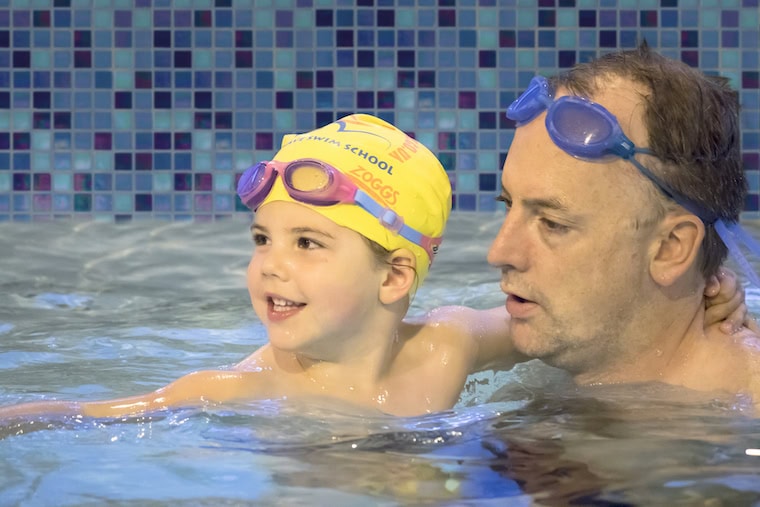
In the water, your body is almost weightless, giving you freedom to move in ways that are harder on land. Because the water supports your weight, swimming is ideal for young children who are still developing core strength and balance, and for adults recovering from injuries.
In the water, your arms, legs, torso, neck and head can move in every direction in a gentle, supportive environment. When you swim a stroke like front crawl, your hands catch the water, your arms pull, your shoulders rotate and your legs kick continuously to keep you balanced at the surface. You also turn your head to breathe in a steady rhythm. That’s what makes swimming a true all-over body workout.
Being in water gives people of all ages a sense of calm. Many people find it soothing, and children especially often relax and become more playful in the water.

Family swimming is a great way for parents and children to spend quality time together. Sharing a fun, relaxed activity in the water helps build bonds and happy memories.
For people whose movement is limited by old or new injuries, exercise on land can be uncomfortable. Because the water supports your body, exercising in a pool puts much less strain on your joints. This makes it easier to move, stretch and build strength in ways that might be too painful or difficult on land.
At Blue Wave Swim School, we teach children and toddlers to swim in small groups or one-to-one at Wimbledon College.



A good swim school with professional staff


Blue Wave Swim is an outstanding swim school that I would highly recommend. The teachers are professional, patient, and genuinely care about every child’s progress. They keep a watchful eye on each swimmer, making safety their top priority while building confidence in the water.(May Achour July 2026).

October 6, 2026, Google Reviews
Highly Recommended. Our girls, two sisters aged 7 and 5, loved the teacher, looked forward to their semi-private courses, and made significant progress in two weeks (Mr B Mashhoodi September 2026).

October 6, 2026, Google Reviews
My son has been going to swimming lessons at Blue Wave in Wimbledon for a few years now and thoroughly enjoys it. The teaching is great and the lessons well run. Helps to prepare him for when we finally get to go on holiday again!

September 26, 2020, www.yell.com
Highly recommend
Highly recommend this swimming school. My daughter has been attending since she was 1 years old and she loves it. The teachers are very good with children and my daughter, who is now 4 years old is very confident in the water.

August 23, 2019, www.yell.com
Great
My daughter loves swimming! Since attending Blue Wave Swim School lessons her water confidence is high and that gives us peace of mind when she is playing near water. The staff are fantastic and the lessons are fun!

August 23, 2019, www.yell.com
Excellent Wimbledon Swimming School
Our children, now ages 9 and 7, have been taking lessons with Blue Wave since early 2017. They have made great progress with their swimming skills. We have been very impressed with the teaching and personalised attention both children have received. Best of all they enjoy and look forward to their lessons. The location is also convenient for Wimbledon residents.
August 23, 2019, www.yell.com
Kids love coming and I can see the development over the weeks. I can see the teachers laying down foundations for a lifetime of swimming – very reassuring as a parent and exactly why you choose a swimming school rather than go it alone
August 23, 2019, www.yell.com